Macroservices (Mini-Services): Filling The Gap Between Monoliths and Microservices
1. Introduction
In the evolving world of software, choosing the right architecture can make or break an application’s success. Over time, companies have experimented with various architectural styles — from Monoliths in the early days to Service-Oriented Architecture (SOA) and eventually Microservices — each offering its own set of advantages and challenges. However, many organizations have found that full microservices can be overkill, especially for mid-sized teams and systems not operating at the scale of Netflix or Amazon. Enter Macroservices (Mini-Services), a balanced approach that aims to deliver modularity without the operational overhead of managing countless microservices.
A 2021 O’Reilly survey found that 77% of respondents either planned to use or were already using microservices in production, but 63% reported significant complexity and overhead. Macroservices can bridge this gap by offering many of the benefits of service-based architectures while keeping complexity in check.
2. History of Software Architecture: Monolith, SOA, and Microservices
2.1 Monolithic Architecture
Definition: A monolith is a single, self-contained software application in which all features, modules, and services reside in one codebase and one deployable unit.
Era: Common before the 2000s and still widely used for smaller projects.
Challenges:
- Scalability: The entire application must be scaled together, even if only one part experiences heavy load.
- Deployment Bottlenecks: A single change or bug can delay the release of the entire system.
- Team Coordination: As the application grows, more developers work on the same codebase, leading to merge conflicts and slower development cycles.
Evidence: In a 2019 enterprise survey by Lightbend, 45% of large companies cited “monolithic code complexity” as the top reason they sought new architectures.
2.2 Service-Oriented Architecture (SOA)
Definition: SOA introduced the concept of services that communicate over a network, often via an Enterprise Service Bus (ESB).
Era: Popular in the 2000s, especially in large enterprises needing integration across multiple applications.
Improvements Over Monolith:
- Looser Coupling: Functions encapsulated into services with well-defined interfaces.
- Scalability: Could scale individual services, though not always as independently as microservices.
- Integration: Easier integration with legacy systems via the ESB.
Challenges:
- Complex ESB: The ESB could become a bottleneck or “single point of failure.”
- Heavy Protocols: SOAP-based services often led to network overhead and complex orchestration.
Evidence: According to a 2010 Gartner report, more than 60% of Fortune 500 companies deployed some form of SOA, but nearly 35% reported “unsatisfactory ROI” due to ESB management complexities.
2.3 Microservices
Definition: A collection of small, independent services, each responsible for a single business capability and communicating via lightweight protocols (REST, gRPC, or messaging).
Era: Gained mainstream popularity in the 2010s.
Key Advantages:
- Independent Deployability: Each service can be deployed, scaled, and updated without affecting others.
- Fault Isolation: A failure in one microservice doesn’t necessarily bring down the entire system.
- Polyglot Persistence: Each microservice can use the most suitable database or language.
Challenges:
- Operational Complexity: Requires robust DevOps, logging, monitoring, and distributed tracing tools.
- Service Proliferation: Teams risk creating too many small services, leading to “microservice sprawl.”
Evidence: Netflix famously runs over 1,000 microservices in production, demonstrating extreme scalability but also enormous operational overhead. Uber similarly moved to microservices but struggled with managing hundreds of interconnected systems, necessitating advanced orchestration tooling.
3. What’s Macroservice (Mini-Service)?
Macroservices (often called Mini-Services or Microservices Lite) are larger, domain-focused services that stand between a single monolith and dozens of microservices. Each macroservice typically handles an entire bounded context — a set of related business functionalities — rather than focusing on one tiny function.
Key Characteristics:
- Domain-Centric: Each macroservice covers a broader domain (e.g., “Payments & Billing,” “Product & Inventory”).
- Fewer Deployable Units: Instead of deploying every small feature separately, you have fewer services to maintain and scale.
- Mixed Database Strategies: Macroservices may share a database or maintain separate ones, depending on the domain’s requirements.
- Lower Communication Overhead: With fewer services, there’s less inter-service chatter and fewer network calls than in microservices.
4. Why Do We Need Macroservices? What Gap Are They Filling?
- Bridging Monolith and Microservices: A monolith can become unmanageable, but fully embracing microservices can lead to operational chaos. Macroservices offer a structured decomposition without going to the extreme.
- Reducing Operational Overhead: Managing numerous microservices demands advanced DevOps practices, from Kubernetes orchestration to sophisticated CI/CD pipelines. Macroservices keep service count lower, reducing overhead.
- Team-Sized: One macroservice can be owned by one or two teams, aligning well with the size and skill sets of many organizations. This is in contrast to microservices, where each service might require a dedicated team or squad.
- Scalable Domains: Macroservices still allow selective scalability. If one domain (e.g., “Search & Recommendation”) is under heavy load, you can scale just that macroservice.
Evidence: A 2022 survey by InfoQ found that 48% of mid-market companies (50–500 employees) felt microservices would be “too complicated” for their size, indicating a gap for a lighter but still modular approach.
5. Pros and Cons of Macroservices
5.1 Pros
1. Balanced Modularity
- You gain domain boundaries without incurring the complexity of dozens or hundreds of tiny services.
- Easier for teams to understand end-to-end functionality within one domain.
2. Lower Operational Complexity
- Fewer services means fewer pipelines and simpler service discovery.
- Logging, monitoring, and tracing are more manageable than in a full microservices environment.
3. Selective Scalability
- Allows scaling of specific domains experiencing higher load (e.g., “Checkout” service during Black Friday).
4. Faster Development & Deployment
- Changes in a single macroservice don’t affect the entire system, reducing monolithic “all-or-nothing” releases.
- Teams can deploy more frequently without microservices’ overhead.
5. Easier Transition from Monolith
- Splitting an existing monolith into a few macroservices is simpler than going fully microservice-based.
- Minimizes refactoring risk while still providing benefits of separation.
5.2 Cons
1. Less Fine-Grained Fault Isolation
- A crash in one macroservice can impact multiple features within that domain.
- Fault isolation is not as robust as with microservices.
2. Potential for Domain Overlap
- If domains are not well-defined, macroservices can still become monolithic in nature.
- Shared databases or code can lead to coupling issues.
3. Scaling Entire Domain
- If one part of a macroservice domain is under load, you must scale the entire macroservice.
- This can lead to resource inefficiency if domains aren’t carefully scoped.
4. May Still Require Future Splitting
- A growing domain may eventually need to be split again, potentially leading to re-architecture later.
- Teams must remain vigilant about domain boundaries.
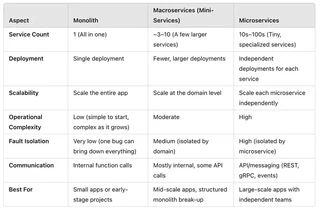
6. Comparison at a Glance
7. Real-World Examples
1. Shopify
- Then: Started as a monolith powering its e-commerce platform.
- Now: Has decomposed the system into larger services (e.g., Storefront, Checkout, Inventory, Billing), rather than hundreds of microservices.
- Benefit: Lower overhead than microservices while still allowing partial scalability during high-traffic events like Black Friday.
2. Airbnb
- Then: Monolithic Ruby on Rails application.
- Transition: Broke the monolith into macroservices such as “Reservations,” “Search,” “Payments.”
- Reason: They needed domain separation to accelerate development but didn’t want to introduce the complexity of microservices overnight.
3. Uber (Early Days)
- Then: Monolithic Node.js backend.
- Transition: Introduced a few mini-services for trip management, driver matching, and payments.
- Outcome: Helped them scale globally before eventually moving toward a more granular microservices approach as they grew bigger.
Evidence: In 2022, a TechCrunch interview highlighted that 30% of mid-stage startups building platforms saw “macroservices” as a strategic stepping stone before potentially going full microservices if required by rapid growth.
8. When to Choose Microservices
1. Massive Scale
- You have millions of daily active users and need to scale specific functionalities independently and aggressively.
- Example: Netflix runs over a thousand microservices to handle streaming, recommendations, user profiles, etc.
2. Multiple Independent Teams
- Different teams want to deploy updates independently (the “two-pizza teams” model).
- Each team owns an entire service from code to database.
3. Requirement for Best-of-Breed Tech
- If you need polyglot technologies (e.g., Java for payments, Python for ML), microservices allow each domain to use the best stack.
- Macroservices tend to stick to fewer stacks to reduce complexity.
4. High Fault Isolation
- A bug in the payments service shouldn’t affect streaming or search.
- Microservices architecture isolates each function at the service boundary.
9. When to Choose Macroservices (Mini-Services)
1. Monolith Is Too Big
- You have a large application that’s becoming unwieldy.
- Deployments take hours, and unrelated features break with a single error.
2. Moderate Scale, Moderate Team Size
- You’re not operating at Netflix scale but need to reduce complexity and speed up deployment.
- A mid-sized team of developers often finds macroservices easier to manage than microservices.
3. Need Partial Scalability
- You want to scale only certain domains (e.g., “Order & Payment” during peak shopping) instead of scaling an entire monolith.
4. Limited DevOps Resources
- Microservices demand advanced tooling for deployment, monitoring, and debugging.
- Macroservices allow for fewer pipelines and simpler operations, making them more practical for smaller or mid-level DevOps teams.
5. Future Flexibility
- You can always split a macroservice into multiple microservices if your system grows significantly and demands more fine-grained scaling.
10. Conclusion
Choosing the right software architecture is a strategic decision that depends on your team size, scalability needs, and operational maturity. Macroservices (Mini-Services) fill a crucial gap between a single monolith and a full microservices setup:
- Monolith: Great for simple, small applications but becomes a bottleneck as you scale.
- Microservices: Ideal for massive, complex systems with many teams but can introduce significant overhead and complexity.
- Macroservices: Provide a balanced approach — giving you modularity, selective scalability, and reduced deployment risk without the exponential complexity that often comes with microservices.
Ultimately, macroservices can be an excellent fit for organizations looking to make a measured, domain-focused transition away from monolithic architectures. By carefully defining bounded contexts, setting up robust DevOps pipelines, and staying vigilant about domain growth, you can enjoy the benefits of a distributed architecture with fewer headaches.
Further Reading & References
- Monolith to Microservices by Sam Newman (for insights on gradual decomposition).
- 2021 O’Reilly Microservices Survey (for industry adoption stats).
- Gartner Reports on SOA (for historical perspective on service-oriented approaches).
- Netflix & Uber Tech Blogs (for real-world tales of microservices complexity).
