Open Banking in Saudi: A Practical Startup Playbook
Data access and user consent are unlocking new fintech products in Saudi Arabia but strict compliance is non‑negotiable.
Why Open Banking Matters in Saudi Arabia

Open Banking is transforming Saudi Arabia’s financial landscape by shifting control of financial data to consumers and enabling fintech innovation. Through secure APIs, banks in the Kingdom can share customer account data with licensed third-party providers only with the customer’s explicit consent. This customer-centric model empowers individuals and businesses to leverage their own banking data — previously siloed in banks — to access tailored financial services and new products. Key reasons open banking matters in KSA include:
- Data Access and Aggregation: Fintech apps can aggregate accounts from multiple banks to give users a unified view of their finances. For example, account information services (AIS) allow a complete, personalized view of finances across different institutions. This transparency helps customers make informed decisions and improves financial literacy in a country with 98% internet usage and a tech-savvy youth population.
- Customer Consent and Control: Open Banking flips the data ownership model — customers are in control of who accesses their financial data and for what purpose. All data sharing requires explicit, informed consent, building user trust through transparency. Consumers can securely share information with chosen apps (budgeting tools, investment platforms, etc.) and regain control over their data, as opposed to banks being the sole custodians.
- Product Innovation and Competition: By opening up data, SAMA (the Saudi Central Bank) fosters a wave of fintech innovation. Startups can develop new solutions like personal finance management (PFM) tools for multi-bank account aggregation, real-time account aggregation, Buy Now Pay Later (BNPL) services, digital lending offerings, and SME financing solutions that were not possible before. Banks, fintechs, and even non-bank businesses can collaborate to create products that improve customer experience, driving competition and diversification of the financial sector in line with Saudi Vision 2030.
In short, open banking in Saudi Arabia means consent-driven data sharing that fuels product innovation. Customers benefit from personalized services and convenience, while fintech startups gain a level playing field to compete and partner with banks. This ultimately leads to a more inclusive, efficient financial ecosystem with new revenue streams and better financial outcomes for consumers.
Who benefits:
Consumers: Greater convenience, transparency, personalized services, and faster loan approvals. Startups: New data-driven products, broader reach through bank partnerships, and lower fraud/friction by leveraging verified bank data. Banks: Collaborative opportunities with fintechs, expanded services for customers, and participation in a growing fintech ecosystem.
Guiding principle: Consent + Least Privilege. If you don’t need a piece of data, don’t request it.
Aligning with SAMA’s Open Banking Framework
SAMA’s open banking journey has three phases: a design phase, an implementation phase, and the go-live phase. This phased roadmap allowed Saudi regulators to engage stakeholders, test standards, and gradually launch open banking services in the market.
Saudi Arabia’s Open Banking rollout is guided by a comprehensive framework from SAMA (Saudi Central Bank) to ensure innovation and regulation progress hand-in-hand. Fintech founders must deeply align with this framework, which defines technical standards, operational guidelines, and compliance timelines for all participants.
- Scope of Services: The first rollout focused on Account Information Services (AIS) — APIs for sharing banking data (accounts, balances, transactions) with user consent. SAMA issued the Open Banking Framework to cover AIS, including detailed legislation, regulatory guidelines, and technical standards. A second phase covering Payment Initiation Services (PIS) is underway: SAMA released the PIS framework, enabling fintechs to initiate payments from user accounts. According to the roadmap, third-party providers (TPPs) like fintech startups are expected to offer payment services soon as the PIS standards roll out. This phased approach (first data, then payments) ensures a controlled expansion of open banking capabilities in Saudi.
- Regulatory and Technical Standards: The framework provides standardized API specifications to ensure interoperability and security across all banks and TPPs. It draws inspiration from the UK Open Banking and Europe’s PSD2, but is tailored to Saudi’s context. Notably, the KSA Open Banking standard introduced customized features like new customer consent types and an extended “Parties” API endpoint that leverages OpenID Connect for robust identity verification. In practice, this means all banks expose data in a consistent format (accounts, transactions, etc.), reducing fragmentation for fintech developers. The framework also includes Customer Experience Guidelines to ensure transparency and simplicity in user interactions (e.g. how consent screens should look), Operational Guidelines for reliability, security, and support processes, and defined Use Cases & Business Rules that clarify permissible activities.
- Open Banking Lab & Sandbox: To support smooth implementation, SAMA launched the Open Banking Lab in 2023 — a secure sandbox environment where banks and fintechs can develop and test their open banking integrations with mock data. This lab provides conformance testing suites to validate that APIs meet the KSA standards before going live. In parallel, SAMA’s broader Regulatory Sandbox is an “always-open” program accepting fintech applications on a rolling basis. This always-open sandbox means startups need not wait for cohorts; you can apply whenever ready, work with SAMA on testing your solution, and get certified for production use. Embracing these facilities is crucial — they reflect SAMA’s fintech-friendly approach but also its expectation that solutions be rigorously tested and compliant before scaling to real customers.
For fintech founders, alignment with SAMA’s framework is both a responsibility and a strategic advantage. It ensures your open banking product meets Saudi regulatory requirements (security, privacy, API specs) and can interoperate with all banks. It also signals to investors and customers that your startup is “fintech compliance KSA” ready. Before writing a single line of code, study SAMA’s open banking documentation and updates. Build your solution to plug into the standard APIs and timelines, and engage with SAMA early (they welcome collaboration and feedback during these evolving phases). This groundwork will save countless headaches and position your startup as a compliant, trusted player in Saudi’s open banking ecosystem.
Open Banking Architecture: Spec-First Approach
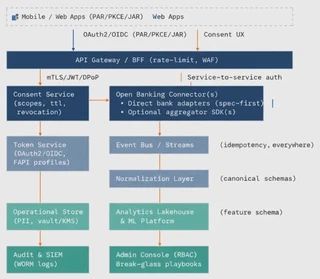
Designing your fintech’s architecture around SAMA’s standards (“spec-first”) from the start will make integration and scaling much smoother. A robust open banking architecture typically includes several layers:
- API Gateway & App Interface: All client (mobile/web) requests go through an API gateway or backend-for-frontend that enforces rate limits, WAF (web application firewall) rules, and input validation. This gateway handles OAuth2 redirects and acts as the front door for your services.
- Consent Management Service: A dedicated service to manage user consent records (scopes requested, consent duration/TTL, status). This handles creating, renewing, and revoking consents and ensures your app only pulls data within the granted scope and period.
- Bank Connector Layer: Modules or microservices that connect to bank APIs. In a spec-first approach, you might build direct adapters for each bank’s open API according to the standard. Optionally, you can also integrate aggregator SDKs/APIs (like those from Tarabut, Lean, etc.) for faster coverage. This layer should use secure mTLS or JWT-based authentication when communicating with banks.
- Token Management Service: Handles the OAuth2 authorization flows with banks (using OpenID Connect and the FAPI profile). It stores and rotates tokens securely (e.g., using a KMS/HSM for encryption), and ensures access tokens are short-lived and scoped. It also manages refresh tokens and their rotation, detecting reuse or tampering to revoke if necessary.
- Event Bus & Data Ingestion: An asynchronous stream or job queue for pulling data from banks once consent is given. This ensures you can process data in the background, with retries, idempotency keys, and back-pressure if a bank’s API is slow or down.
- Normalization & Data Store: A normalization layer translates each bank’s data format into a canonical schema (common data model for accounts, transactions, etc.). Clean, normalized data is then stored in a secure operational database. Sensitive PII (like account numbers) should be encrypted at field-level or tokenized. This database (or data lake) becomes the unified source for your app’s features (e.g., budgeting analytics or credit scoring).
- Analytics & ML Platform: If your startup leverages data for insights or machine learning (e.g. risk scoring, personalized offers), set up a data pipeline from the normalized store to an analytics database or feature store. This could be a separate data warehouse or lakehouse where you run aggregations, train models, and compute derived metrics without impacting the operational store.
- Audit Logging & Monitoring: An immutable audit log system records every data access, consent event, and key action (see below section on logging). Logs should be stored in append-only storage (WORM — write once, read many) and streamed to a SIEM for real-time monitoring and alerts on anomalies.
- Admin & Support Tools: An internal admin console for operations and support, protected by strong RBAC (role-based access control). This allows authorized staff to view logs, assist with user issues, or perform emergency “break-glass” actions (with dual approvals) if needed. All such access is logged for compliance.
Key design tenets for this architecture are idempotency everywhere (so re-fetching or reprocessing data won’t create duplicates), robust timeouts and circuit breakers (so a slow bank API doesn’t hang your system), and a “zero trust” mindset internally (no service should have blanket access to data without going through proper auth checks). All secrets and encryption keys belong in secure vaults or HSMs, not in code or config files. By building to the standardized models and security profiles SAMA provides, you avoid bank-specific hacks and ensure your system can plug-and-play as banks update their APIs or as new banks come online.
(In summary: spec-first, not aggregator-first. Use aggregators for speed to market, but architect so you can swap direct connections in as you grow.)
Consent UX Flows and Building User Trust
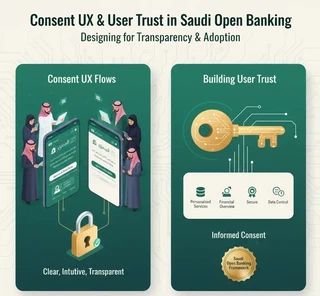
Designing a user consent flow that is clear, intuitive, and trustworthy is paramount in open banking. Since customers must actively grant permission for a fintech app to access their bank data, the UX around consent can make or break adoption. Saudi’s Open Banking Framework explicitly mandates transparency, simplicity, and informed consent in user interactions, so startups should adhere to best practices in both backend process and frontend design:
- Transparent Communication: Clearly explain what data is being requested and why. Users should immediately understand the benefit. For example: “Allow BudgetApp to read your last 12 months of transactions from Bank X to provide spending insights.” Avoid jargon; use the customer’s language (Arabic or English, as appropriate) and keep consent screens concise and easy to read.
- Granular and Time-Bound Consent: Wherever possible, let users choose the scope of data access. If your app only needs read-access to savings account transactions, don’t request access to all accounts. SAMA’s standards provide for multiple consent types and scopes, so leverage that flexibility. Also, inform users that consent is not open-ended — it might expire after a certain period (e.g. 90 days) unless renewed. This gives users confidence that they aren’t giving a “blank check” forever.
- Redirection to Bank for Authentication: A hallmark of open banking UX (in KSA and globally) is that the user authenticates directly with their bank during consent. In practice, your app will redirect the user to their bank’s secure login page (or app) where they log in and authorize the data sharing, often using multi-factor authentication or biometrics. The fintech app never sees the user’s banking password. Emphasize this flow in your UI (e.g. “You will be securely redirected to your bank to approve this request”). This builds trust, as users feel safer granting access via their familiar bank interface. It also aligns with SAMA’s security principle that banks handle the actual authentication, and TPPs (fintechs) do not store sensitive credentials.
- Consent Management and Revocation: Treat consent as a living preference that the user controls. Provide an in-app dashboard or settings page where users can see what consents are active (which banks/accounts are linked) and easily revoke consent at any time. Robust open banking implementations include technical processes to ensure revocations are honored immediately. From a UX perspective, make revocation as easy as one or two clicks — paradoxically, this increases trust, as users are more willing to grant access if they know it’s simple to undo. Also, send users periodic reminders or notifications of their active consents (e.g. “Your Bank X account data sharing with BudgetApp is set to renew next week”) as required by good practice and regulation.
- User Education and Onboarding: Don’t assume every user in KSA is familiar with open banking. Briefly educate users during onboarding or the consent process about what open banking is and how SAMA regulates it for their safety. Mention that your app uses secure, SAMA-approved channels and that no data is accessed without their explicit approval. Highlight security measures (encryption, regulatory oversight, the fact they authenticate via the bank) to preempt common fears. Building this knowledge into your onboarding increases user confidence in both your app and the concept of open banking generally.
By focusing on a consent-first UX, fintech startups can establish a strong trust model with customers. When users feel in control and safe, they are more likely to try new open-banking-powered services like yours. Remember that conversion at the consent step is critical — any confusion or doubt there, and users will drop off. Instrument your funnel to detect issues: measure how many users start the consent process vs. successfully return from the bank, where drop-offs happen (e.g. at bank login), and how long the process takes on average. Gathering such telemetry (and even reasons users revoke access) can highlight UX pain points. Thus, invest in user testing for your consent flow, follow SAMA’s customer experience guidelines, and learn from global best-in-class examples (e.g. popular UK open banking apps) to continually refine the process. Ultimately, a seamless consent experience builds the foundation for a long-term trust relationship between your fintech and its users.
Data Normalization Strategies for Multi-Bank Integration
One technical challenge for open banking fintechs is handling data from multiple banks’ APIs and making it uniform. Even with SAMA’s standardized API specifications, different banks might have slight variations in implementations or data formats. As a startup, you need a strategy to normalize and standardize financial data coming from various sources so that your product can use it consistently.
- Leverage the KSA Standard: The good news is Saudi’s Open Banking Framework enforces a baseline schema for accounts, transactions, beneficiaries, etc. This ensures that, for example, all banks will provide an account object with certain core fields (account number, IBAN, currency, balance, etc.) and transaction records in a defined structure. Make sure your developers thoroughly understand the KSA Open Banking data model and build your internal data structures around it. If all banks follow the spec closely, your app can parse their responses with a common parser and data model.
- Handle Minor Variations and Extensions: In practice, banks may extend the standard or have optional fields (e.g. additional transaction metadata) in their APIs. Plan for a data mapping layer in your backend that translates each bank’s responses into your app’s canonical format. This may involve writing adapters or using an intermediary library. For instance, one bank might label a field “postingDate” vs another using “transactionDate” — your normalization layer should map both to your unified internal field (e.g.
date). Also be mindful of data types and formats (some banks might use different date string formats, etc.). Rigorous testing with each bank’s sandbox API is key to ironing these out. - Use Aggregation Platforms (if suitable): To accelerate multi-bank connectivity, many Saudi fintechs partner with open banking intermediaries or aggregators. Offering a single unified API that aggregates data from many banks. By integrating with such platforms, a startup can offload much of the normalization effort to them — you get standardized data feeds, and they handle the connections to individual banks behind the scenes. The trade-off is dependency and cost, but it can greatly speed up development and ensure comprehensive bank coverage, especially in early stages. (As a rule of thumb, if your product’s differentiation lies mainly in analytics or user experience, an aggregator can be a great starting point; but if you’re building a broad platform or are heavily payment-focused, investing in direct bank integrations sooner is wiser.)
- Consistent Data Modeling: Whether you integrate directly or via an aggregator, define a consistent data model internally. For example, create unified classes or objects for a
CustomerAccount,Transaction, etc. that your application logic will use. Run all external data through a transformation into these canonical objects. This ensures the rest of your system and analytics are agnostic to the data source. If you plan to introduce new banks or even non-bank data (e.g. telecom bills in a future Open Finance scope), your existing model should accommodate those with minimal changes. - Data Quality and Enrichment: Normalization isn’t just structural; it’s also about making the data useful. Implement strategies to clean and enrich data after aggregation. Transaction descriptions, for instance, can be cryptic — consider parsing or using third-party services to categorize transactions (e.g. identify merchant names, classify spending into categories like groceries, utilities, etc.). Ensure consistent categorization across all banks’ data to power features like spending analysis or credit scoring. Remove duplicates or overlaps (if a user reconnects an account, ensure you don’t double-count historical data). Maintaining a high-quality, normalized dataset will directly impact the quality of your product’s insights (accurate budgets, reliable credit scores, etc.).
In summary, robust data normalization is crucial for any multi-bank fintech solution. Saudi’s open banking ecosystem gives you a head start with its standard, but the onus is on your startup to perfect the process. Plan for an ongoing effort: as banks update their APIs or as Phase 2 (payments) comes in, you’ll need to adapt your normalization logic. By investing in this layer, you ensure that your app can scale across banks and deliver a seamless experience — where a customer’s data looks the same regardless of which bank it came from. This consistency builds user confidence and enables you to apply uniform analytics or features on top of the aggregated data. (Aim for high data quality: e.g. >99% deduplication accuracy and minimal uncategorized transactions, so users and regulators alike trust your outputs.)
Security Scope Management and User Access Control
In a financial app environment, security is non-negotiable, and open banking adds unique considerations. Fintech startups must implement strong scope management and access controls to ensure that data access is limited to what’s authorized by the user and that both external and internal access are tightly governed. Here’s how to approach security and access control in the context of Saudi open banking:
- OAuth 2.0 and Fine-Grained Scopes: Open Banking in KSA uses an OAuth 2.0–based authorization flow (like other regions), typically enhanced with the Financial-grade API (FAPI) security profile for higher security. When a user grants consent, the result is an access token issued to your app with specific scopes. Scopes define exactly what your app can do — for example,
accounts.read,transactions.read, orpayments.initiate. Your implementation should request only the scopes needed for your service. More importantly, once you have a token, your app must strictly use it only for the allowed APIs. SAMA’s standards and the bank APIs themselves will enforce this (e.g. a transactions API call will fail if your token only has accounts access), but you should also design your software to respect scope boundaries. Never attempt to circumvent or “over-reach” on data access – not only will that fail compliance, it also erodes the trust model of open banking. - User-Level Access Isolation: Each user’s data must be compartmentalized by their own consent and token. Architect your backend such that every service call to fetch data always operates in the context of a specific user identity and token. Avoid any design where a general system-wide token or credential could access multiple users’ data — that violates the principle of least privilege. Instead, tie every data request to a user-specific access token stored securely (e.g. encrypted in a database or vault). Additionally, build safeguards so that one user’s data never gets exposed to another by mistake (strong multi-tenant data separation). On the front-end and in internal APIs, use strong user authentication and session management so requests are always tied to the correct user context.
- Internal Access Control and Auditing: Within your company, enforce strict policies about who (or what systems) can access sensitive customer data. Use role-based access control (RBAC) or attribute-based control in your internal dashboards and databases. For example, maybe only compliance or support officers can view certain raw data, and even then only when necessary. All access by administrators or engineers should be logged (we’ll cover audit trails next) and periodically reviewed. Adopting an Identity and Access Management (IAM) framework is wise as you scale. Also consider using separate cloud environments or accounts for different data domains (e.g. an isolated environment for handling payments vs. general account info) to limit the blast radius in case of a breach.
- Encryption and Data Protection: Treat any data retrieved via open banking as highly sensitive personal financial data. Follow SAMA’s cybersecurity guidelines (aligned with global standards) by encrypting data both in transit and at rest. Use strong protocols (TLS 1.2/1.3) for API calls. At rest, use field-level encryption for particularly sensitive fields like account numbers or IBANs (or avoid storing full account details if not necessary). Mask or tokenize data wherever possible — for instance, card numbers (PAN) are often masked by the bank APIs themselves, so your system never even sees the full PAN, reducing your PCI-DSS scope. Ensure any secrets (API keys, client secrets, certificates) are kept in secure vaults and not hard-coded or exposed in logs.
- Fraud and Anomaly Detection: Security scope management isn’t only about normal operations, but also about detecting misuse. Implement monitoring to catch anomalous access patterns — e.g. if suddenly your system is pulling unusually large volumes of data for a single user, or if there are repetitive, rapid payment initiation attempts. These could indicate abuse or a compromised token. Some open banking implementations include fraud analysis layers and notification hooks; design your system to leverage such signals (from banks or your own analytics). If a bank or user revokes consent, your app should immediately stop accessing data and securely delete or archive previously fetched data per your data retention policy.
By diligently managing who can access what, you uphold the security promises of open banking. SAMA and the banks take security extremely seriously — the open APIs are built to bank-grade security standards and have undergone extensive hardening. Your startup must match that diligence. Embracing frameworks like OAuth 2.0 with FAPI, OpenID Connect for identity, and robust internal controls will not only keep you compliant but also protect your reputation. In fintech, a single security lapse can be fatal to user trust. Conversely, a strong security posture can be a selling point, especially when dealing with something as sensitive as personal financial data. Always err on the side of caution: access less, secure more, and continuously review and test your security measures as you grow.
Leveraging Open Banking Data for Risk Scoring and Credit Modeling
One of the most powerful opportunities for fintech startups in open banking is using banking data to enhance credit risk models and financial analytics. Traditionally, lenders in Saudi Arabia relied on credit bureau scores and static income documents to make decisions. Now, with user-permissioned access to bank account histories, fintechs can perform “cashflow-based underwriting” and more nuanced risk assessments. Here’s how open banking data can be leveraged in real-world use cases:
- Income and Expense Verification: With AIS access, a fintech lender can pull an applicant’s recent bank transactions directly from their accounts to verify income deposits, salary consistency, and recurring expenses. For example, micro-lending and consumer loan providers in KSA use open banking to instantly assess an applicant’s ability to repay. This replaces the need for uploading bank statements or payslips, speeding up loan approvals while reducing fraud (since data comes directly from the bank). Consistent salary credits, overall cashflow patterns, and existing debt obligations seen in the account can feed into an automated scoring model to make fast credit decisions.
- Behavioral Credit Scoring: Going beyond static metrics, transaction data allows analysis of spending habits and financial behavior. Machine learning models can be trained on categorized transaction histories to predict risk. For instance, frequent overdrafts or gambling-related transactions might signal higher risk, while steady savings or regular investment contributions might signal a financially responsible customer. Banks in Saudi Arabia can increase risk assessment accuracy by incorporating such open banking data into their credit scoring models. Fintech startups focused on lending, BNPL, or credit card issuance are already exploring these models — e.g. a BNPL provider could check a user’s recent account balances and spending behavior to set responsible spending limits. In fact, some Saudi BNPL services (like Tabby) reportedly leverage open banking integrations (via providers like Lean) to inform their instant credit decisions, ensuring customers are not over-leveraged.
- SME Credit and Cashflow Lending: Open banking isn’t just for retail consumers; small businesses can also benefit. An SME financing fintech can use open banking to aggregate a company’s accounts across different banks to get a holistic view of cash flows. This is particularly useful in KSA where many SMEs may not have extensive credit histories. By analyzing patterns such as revenue inflows, expense outflows, seasonality, and average balances, a lender can perform cashflow-based lending. This approach, enabled by open banking data, provides more competitive lending options to SMEs and improves risk evaluation by using real, recent financial data instead of just outdated statements. For example, a working-capital fintech could automatically pull the last 12 months of transactions from a business’s bank accounts and feed it into a risk model that predicts likelihood of default more dynamically than a traditional score.
- Personal Financial Management & Advice: While not a traditional “credit” use case, it’s worth noting that startups providing PFM tools can also derive insights that border on credit modeling. For instance, an app that aggregates a user’s accounts and analyzes spending could proactively advise the user on their affordability for new credit or predict when they might face cash shortfalls. Over time, such an app might even offer tailored micro-loans or lines of credit when it sees the user’s risk is low and they might need extra funds — all derived from open banking data. Innovative services like automated savings or investment advisors also use risk-modeling concepts (assessing how much a user can save or invest given their cashflow).
- Improving Financial Inclusion: A broader impact of using open banking for risk assessment is expanding credit to underserved populations. Saudi Arabia has a large youth population and many gig-economy workers who may not have substantial credit history. However, if they use bank accounts, their transaction data can demonstrate their financial behavior. Fintech startups can tap into this to responsibly lend to segments that banks traditionally found difficult to score. By using comprehensive, verified transaction histories instead of just bureau data, lenders can approve more people for loans or credit at fair rates, reducing defaults by truly understanding the borrower’s financial picture.
When building such data-driven credit models, you’ll likely ingest 12–24 months of transaction history per user via AIS, normalize and enrich it, then aggregate it into useful features (covering income stability, expense patterns, liquidity buffers, etc.). You can then train predictive algorithms (e.g. gradient-boosted tree models) to score risk or affordability. Throughout this process, handle the data responsibly: user consent is not just a legal checkbox — use the data only for the stated purpose (e.g. credit scoring) and ensure decisions remain free of prohibited biases. Maintain explainability in your models (e.g. provide reason codes like “high discretionary spending affected your score” to users) and practice strong model governance (version your models, test for fairness, monitor for drift over time). Also, make sure to explain decisions or give insights back to the user when possible (“Your spending on subscriptions is high, which affected your credit offer — here’s how you could improve”). This keeps users engaged and informed about how their data is being used.
Finally, remember that credit modeling is heavily regulated — if you’re providing lending or credit scoring services, you may need additional licenses from SAMA. But the combination of open banking data + smart analytics is a game changer. It leads to faster decisions (loans approved in minutes), more personalized credit (amounts tailored to one’s actual cashflow), and overall a more dynamic lending market in Saudi Arabia. Startups that master this will play a key role in driving the Kingdom’s fintech innovation forward by both managing risk better and extending financial inclusion.
Logging and Audit Trails for Compliance
In the highly regulated context of open banking, maintaining comprehensive logs and audit trails is not just good practice — it’s a compliance necessity. Fintech startups must be prepared to demonstrate to regulators like SAMA that every customer’s data access was authorized and appropriately handled. Implementing robust logging and monitoring from day one will save you headaches later and ensure you meet governance standards. Key considerations include:
- Consent Audit Logging: Every time a user grants, denies, or revokes consent, record it. This log should include the user identity, the exact permissions (scopes) granted, timestamp, and context (e.g. which interface or device was used). In case of any dispute or inquiry, you should be able to pull up a consent history for each customer. SAMA’s Customer Experience Guidelines emphasize informed consent — an audit trail proves you obtained that consent properly. Also log when consents expire or are auto-renewed (with user action). Many open banking systems generate a consent ID or record; ensure you store that and tie it to the user’s profile.
- API Access Logs: For every API call your system makes to a bank’s open banking API (whether to fetch account info, transactions, or initiate a payment), log the details. At minimum capture: which user/token was used, what endpoint was accessed (e.g.
"GET /accounts/{id}/transactions"), the timestamp, and whether it was successful. Do not log sensitive payload data in plaintext (to avoid creating another security risk), but you can log metadata like number of records fetched or the amount in a payment initiation. These logs create an audit trail of data access – demonstrating that you only accessed data when you had a valid consent and token, and exactly what was retrieved. They are invaluable for troubleshooting as well as for future audits by SAMA. (In many jurisdictions, regulators can ask a fintech: “Who accessed customer X’s data and when?” – you should be able to answer that quickly from your logs.) - Security Monitoring and Alerts: In addition to basic logs, set up monitoring on those logs to catch anomalies. For instance, if there are repeated failed attempts to access data (could indicate an expired token or a possible breach attempt), alert your security team. If a normally low-volume API suddenly spikes in usage, investigate it. Having an automated log monitoring system (a SIEM — Security Information and Event Management tool) helps flag suspicious events in real-time. This ties into compliance because regulators expect you to not just record, but also act on security incidents swiftly. It also helps meet SAMA’s cybersecurity framework requirements, which call for continuous monitoring of systems.
- Audit Trail for Data Handling and Changes: Beyond external data access, log any internal handling of that data. For example, if a support agent views a customer’s account data in your admin panel, log that action (e.g. “Agent A viewed Customer Y’s transactions at time Z”). If any data is transformed, exported, or deleted, log those events too. Also track changes in critical configurations — e.g. if someone updated the permissions of an API client or changed a callback URL for your open banking integration, record it. This level of logging ensures accountability inside your organization. In case of any irregularity, you can trace it to a root cause (for instance, if a user complains “I revoked consent but my data was still accessed afterward,” you can investigate the timeline via logs).
- Retention and Protection of Logs: Treat logs as sensitive data too. They often contain user identifiers and timestamps of activity that could be pieced together to reveal patterns. Secure your logs — use append-only storage or write-once mediums to prevent tampering. Also, maintain them for an adequate period. SAMA or other authorities may require logs to be kept for several years. In absence of specific guidance, many fintechs keep audit logs for at least 5 years, aligning with general financial record-keeping practices. Use efficient log management solutions so performance isn’t impacted as log volume grows. Minimize personal data in logs as well — for example, log user IDs or transaction IDs instead of full names or details, and keep a separate reference if needed.
A strong logging and audit trail regime ensures transparency and accountability in your operations, which is exactly what regulators want to see. It also streamlines your internal compliance: when the time comes for audits, you won’t be scrambling to piece together records. Instead, you can confidently provide evidence of every consent and data exchange, demonstrating adherence to the Open Banking Framework and broader data protection laws. In the words of industry guidelines, better logging leads to “improved financial transparency” and more efficient oversight. For a Saudi fintech aiming to build trust with both users and regulators, investing in these compliance capabilities is as important as building the product’s features.
From Sandbox to Production: A Compliance Checklist
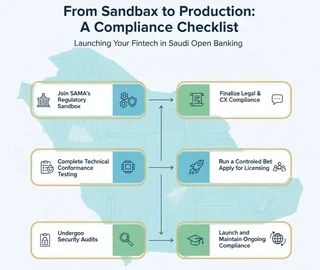
Launching an open banking–powered fintech product in Saudi Arabia requires careful navigation of regulatory milestones and thorough preparation. Below is a practical checklist for founders to ensure a smooth journey from initial development in the sandbox to full production deployment. Following these steps will help satisfy SAMA’s requirements and achieve “fintech compliance KSA” status:
- Join SAMA’s Regulatory Sandbox: Start by applying to SAMA’s fintech sandbox program, which is always open for applications. Prepare a clear application detailing your open banking use case, business model, and readiness to test. SAMA will evaluate eligibility against criteria like innovation, consumer benefit, and readiness. Once accepted, you’ll receive a temporary permission (Letter of Approval) to operate in the sandbox after meeting any initial requirements.
- Ensure Operational Readiness: Before you can start testing with real users or live bank integrations, SAMA will assess your operational readiness. This typically involves meeting an assessment criteria checklist provided by the regulator. Key items include having proper risk management, customer disclosures, systems security, and governance in place. For open banking, make sure you have robust cybersecurity measures aligned with SAMA’s framework (covering data encryption, access control, etc., as discussed above) and clear customer consent flows and privacy policies documented. This stage might also require demonstrating your technology in a controlled setting or providing evidence of thorough internal testing.
- Technical Conformance Testing: Utilize the Open Banking Lab and related sandbox tools to test your API integrations. Validate that your app can connect to banks’ APIs and perform the expected functions (data retrieval or payment initiation) according to the KSA Open Banking standards. You may need to run conformance tests provided by SAMA to certify that your implementation complies with the Open Banking API specs. Fix any issues that arise — it’s easier to resolve them in the sandbox than post-launch. Also ensure you handle error conditions gracefully (e.g. if a bank API is down or returns an error) as part of your testing.
- Security Review and Certifications: Before going live, conduct comprehensive security reviews. This includes penetration testing by reputable third-party firms to probe your application and backend for vulnerabilities. Address any findings (SAMA may ask for the pen-test report or a summary). Additionally, consider obtaining relevant certifications: for instance, ISO/IEC 27001 for information security management can demonstrate your commitment to data security. If your app involves payments and touches any card data (though open banking APIs avoid full card info), ensure compliance with PCI-DSSstandards — even if not strictly required, it’s good practice. Some fintechs also undergo SOC 2 audits for data handling. While not all of these certifications are mandated, they can speed up regulatory approval and build trust with bank partners. (SAMA’s assessment will definitely include cybersecurity compliance, so use their guidelines as a baseline for required controls.)
- User Experience and Consent Compliance: SAMA (or its sandbox team) might review your app’s interface, especially around how you obtain user consent and disclose information. Be prepared to show screenshots or demo the flow to regulators. Ensure your terms of service and privacy notices are compliant with Saudi laws (like the Personal Data Protection Law) and clearly state what data you collect and how it’s used. Any third-party partnerships (e.g. if you’re using an aggregator like Lean or Spare) should be disclosed as well. Having a legal/compliance advisor review these before submission to SAMA is advisable.
- Gradual Testing (Beta Launch): Once you have SAMA’s interim green light, you’ll enter the Testing Phase in the sandbox (up to 12 months). Use this period to run a controlled beta launch. Onboard a limited number of users (perhaps start with friends & family or a small pilot group) to test your service in real conditions. Closely monitor outcomes, collect user feedback, and demonstrate that you can operate safely at a small scale. SAMA may require periodic reports during this phase — including user metrics, any incidents, and results versus your projected outcomes. The goal is to prove that your solution works as intended and delivers benefits without undue risk.
- Regulatory Approval and Licensing: Upon successful sandbox testing (which usually requires at least ~6 months of operation), you will prepare to exit the sandbox. This involves compiling a final report of your test findings and how you met all objectives. If everything is satisfactory, SAMA will allow you to graduate from the sandbox. At this point, depending on your business model, you may need to apply for a full operating license or obtain a specific approval to continue business. For an open banking TPP, this could mean an Account Information Service Provider (AISP) license or similar registration. SAMA’s market activation plan will detail what license or authorization is needed for each type of participant. Ensure you have all documentation ready (business plans, security policies, etc.) when applying for the full license. In some cases, startups partner with licensed institutions or operate under an agency model — for instance, a fintech could operate under an arrangement with a licensed open banking platform like Lean until it obtains its own license. Choose the path that fits your strategy, but make sure SAMA is in agreement.
- Scaling to Production and Ongoing Compliance: With the full license or approval in hand, you can officially launch to all customers in Saudi Arabia. From here, treat compliance as an ongoing effort. Maintain all the logs, security practices, and user protection measures discussed. SAMA may conduct supervisory inspections or require regular compliance reports. Also, stay updated on any framework updates — for example, when Phase 2 (payments) fully rolls out, ensure your services comply with any new standards or update your app to offer new features under the new guidelines. Continue to engage with SAMA and industry forums; Saudi’s open banking is evolving (with Open Finance on the horizon beyond banking), so being an active participant will keep you ahead. Lastly, consider joining Fintech Saudi’s events or communities, where other startups and banks share learnings — this camaraderie can help in tackling common challenges and perhaps shaping future regulations. In parallel, run your operation like a bank: keep an eye on key performance indicators of your service. Measure consent conversion rates (what percentage of users successfully link their accounts), data freshness (how up-to-date the retrieved bank data is), coverage (e.g. number of accounts or banks connected per user), system reliability (uptime and data ingestion success rates), risk outcomes (loan approval vs. default rates if you’re lending), and security metrics (like average time to revoke a compromised token). Tracking these KPIs helps ensure you’re delivering on the open banking promise while staying safe and compliant.
Even with the above roadmap, be mindful of common pitfalls that have tripped up open banking startups. Frequent mistakes to avoid include:
- Requesting over-broad data scopes — this leads to low user conversion (people abandon consent if you ask for too much) and can invite regulatory scrutiny.
- Treating an aggregator’s SDK/API as a black box — over-reliance on a third-party without understanding its limits can cause opaque failures and vendor lock-in.
- Skipping a canonical data schema — if you don’t standardize data internally, you’ll accumulate analytics debt and brittle, bank-specific code that’s hard to maintain.
- Weak revocation handling — not immediately honoring consent revocations (or deletions) violates PDPL and undermines user trust. Build the plumbing to purge or stop data flows as soon as consent is withdrawn.
- Logging sensitive data in plaintext — dumping bank payloads or user info in your logs or analytics unmasked can dramatically increase the impact of a breach. Always sanitize or encrypt sensitive fields end-to-end.
By following this checklist — and avoiding the above pitfalls — fintech founders can confidently navigate the journey from an idea to a fully compliant open banking product in KSA. The process may seem intensive, but it’s designed to ensure customer safety, data security, and financial stability — all of which ultimately benefit your startup through increased user trust and a level playing field. Saudi Arabia is positioning itself as a global fintech hub, and regulators are quite supportive of innovators who do things the right way. As you graduate from sandbox to production, you’ll not only have a viable product but also the credibility of having met SAMA’s high standards, which is invaluable for winning customers, bank partnerships, and investor confidence. Good luck on your open banking journey in the Kingdom, and remember: compliance and innovation go hand-in-hand in unlocking the full potential of Saudi open banking for your startup’s success.
